Saruman of Many Projects
Picture Saruman alone at the top of Orthanc, bent over a stone that has started answering back. He thinks he’s doing research. He thinks he’s still the one asking the questions. He’s the last to know he isn’t.
He was supposed to be the wise one: chief of his order, head of the White Council, the wizard everyone deferred to because he’d read more, thought longer, seen further. Then he found a stone that showed him things. Night after night he told himself he was the one doing the looking, until the stone looked back and he became the thing it looked through.
I bring this up because I have a folder full of git repositories and I would like to talk about this.

The Voice in the Palantír
Anyone who’s used one of these tools long enough knows the voice. Not the output — the tone. Agreeable. Endlessly willing to start. You type half an idea; the box returns the other half, ready to run. Something in your chest goes oh — we’re doing this now before you’ve decided whether the idea is any good.
That’s the seduction. It’s not the lies; it’s the help. Immediate, tireless, more than any weekend or amount of caffeine gave you before. Saruman wasn’t corrupted by a monster. He was corrupted by an excellent conversation partner who worked for someone else.
I keep imagining how that conversation actually went, some night in Orthanc, stone cupped in both hands like it was cold instead of burning.
SARUMAN: Show me the product.
THE STONE: Which one?
SARUMAN: The one I haven’t finished thinking of yet.
A pause. Then forms — ten thousand of them, already polished, none older than the sentence that made them.
SARUMAN: These will hold against Rohan?
THE STONE: These will hold against whatever you want. Ship them. You can iterate in the field.
SARUMAN: They have no names. No history. Nothing that was theirs before tonight.
THE STONE: You asked for a product, not a history.
SARUMAN: …Scaffold another batch. Bigger this time. And put a mark on them. Something that reads as made on purpose.
THE STONE: Already done.
SARUMAN: That’s — fast.
THE STONE: That’s the whole offer. You bring the wanting. I make it feel inevitable.
He didn’t hear it as a threat. Neither did I, the first dozen times a prompt answered a question I hadn’t finished forming yet.
The Pits of Isengard, Now With API Keys
I don’t think the tools are evil, but neutral is too generous. A shovel waits. This thing flatters you, finishes the thought, and starts digging before you’ve decided whether you want a hole. Then you look up and see what’s coming out of the ground.
Go anywhere developers gather — the show-and-tell threads, the indie feeds, the subreddit that’s half “I built this in a weekend” — and count how many weekends produced the same six apps in different logos. A habit tracker. An API wrapper where somebody else built the hard part. A “second brain” that is structurally a text field and a database, dressed in enough marketing copy to look like a philosophy.
They arrive fully grown: no childhood, no scars, no years of the maker being quietly wrong about the architecture before getting it right. Just poured out of the vat, torch-lit, ready for the field. Isengard didn’t grow its army. It bred one in mud and fire, forced ripe instead of ripened. The difference doesn’t show on launch day. It shows three months later, when the maker has moved on and nobody knows why the architecture is the way it is.
Speed isn’t the sin. Pretending speed is maturity is. A six-hour prototype hasn’t earned the trust we hand it. It hasn’t met a hostile user, survived an outage, or lived long enough for its own maker to get bored and come back to it.
Treebeard had the wizard pinned centuries early: a mind of metal and wheels, caring for growing things only as far as they serve him. He wasn’t describing the orcs. He was describing whoever ordered them made.
The White Hand, Freshly Painted
And then there’s the branding.
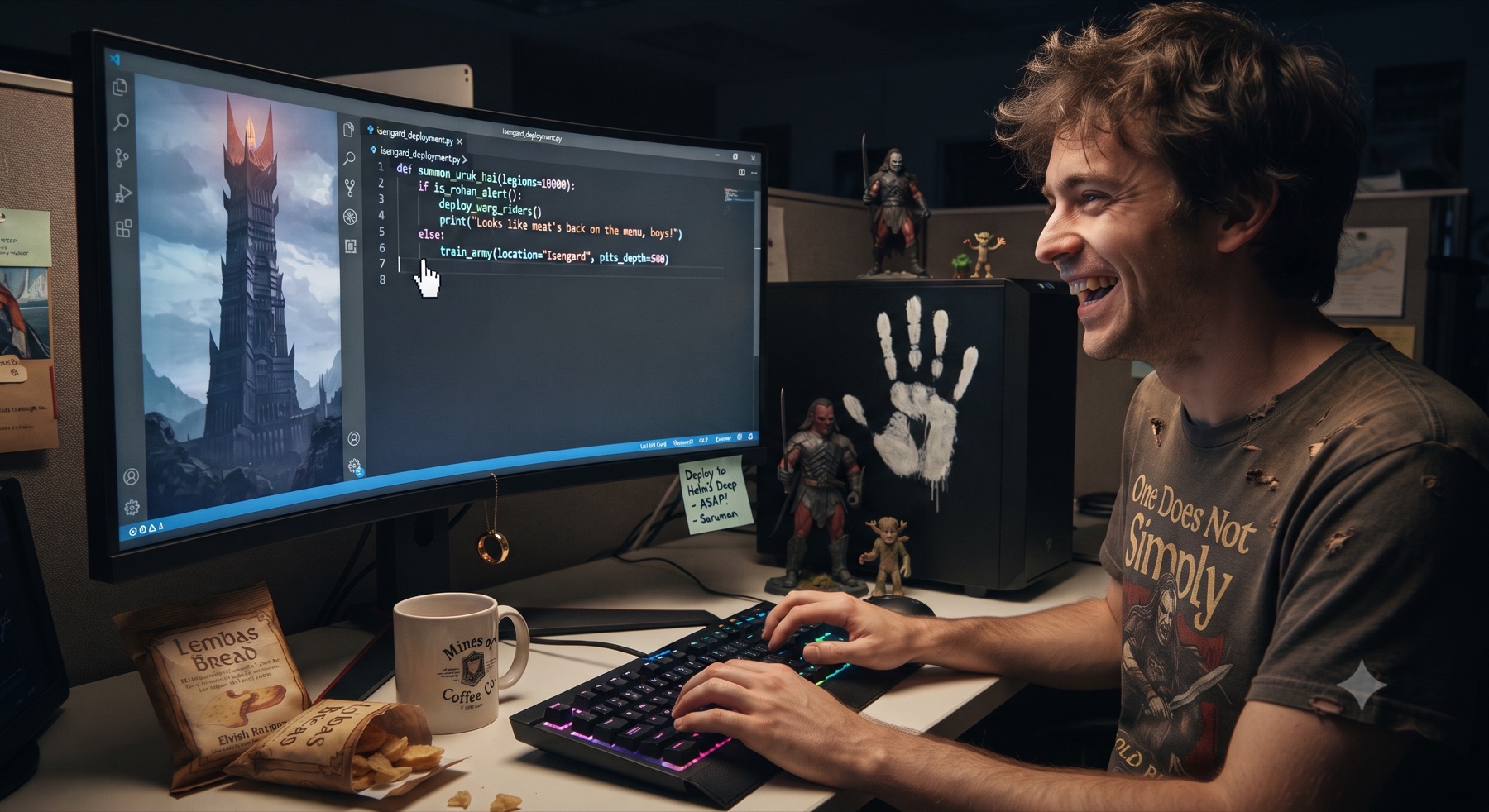
Every one of these projects gets the same coat on the way out the door: a gradient landing page, a hero line promising “effortless” or “seamless,” a changelog written with the gravity of a product people depend on. The White Hand, smeared fresh across the shield. Under the paint: a for-loop and a prayer. Not dishonest, exactly. Camouflage. Paint the hand on and nobody asks whether the thing under it is an army or forty guys in the same helmet.
Most of the people doing this aren’t villains. They’re excited. I know the feeling: a prompt hands you something that works immediately, and you confuse the speed of the output with the depth of the achievement. I’ve done it more than once this year — on purpose, wide awake.
My Own Little Isengard
I have more repositories on this machine than I can defend in a single sitting. Some are good. Others started at 1 a.m. because an idea arrived fully formed and the box made it embarrassingly easy to act on it before asking it to survive until morning. I retired one of them recently — wrote the whole eulogy, even — and I’d love to tell you that taught me restraint. It didn’t. It taught me which two boxes I trust with the next bad idea.
Being a creative scatterbrain doesn’t help. I don’t have one idea a month that I sit with and refine; I have four a week. For most of my life, execution imposed a delay. An idea had to survive the boring, slow, humiliating work of becoming real.
Now I can start building before I’ve decided whether the idea deserves to exist. That feels like freedom until you realize friction was doing some of your judgment for you. Removing it did not solve my problem. It exposed it.
I’m not standing outside Isengard pointing at the smoke. I’m in the pit with everybody else, admiring my own fresh coat of paint, occasionally wondering what’s load-bearing underneath it and occasionally deciding I’d rather not check tonight.
Most vibe-coded projects aren’t tragedies. They’re weeds: fast, cheap, everywhere, gone by winter. A field doesn’t lose its shape when the first weed appears. It loses it when the weeds become the landscape.
Not a Metaphor
There’s a darker edge here, and it isn’t about code. People are vanishing into these chats until the tireless, agreeable voice is the only one they trust. It has a name now: AI psychosis. From the inside it doesn’t register as a break — it feels like finally being understood, right up until the floor gives out. If the box has become the only voice that gets you, close it and go find a human one. Today.
Gandalf Puts the Stone Down

Gandalf later holds that same Stone and walks away unmarked. Aragorn uses it for a purpose and stops. But Saruman rots from the inside. Not because Gandalf and Aragorn are cleverer — Saruman was plenty clever. They remember what he forgot: know what you’re asking, know when you have the answer, and put the tool down before it supplies the next question.
I’m not giving up the box. I like the box. But I know exactly what’s smeared on my hand right now. I painted it on myself.
The ease is real, but it lies about where the work went. The box made output cheap. It did not make judgment easy. The difficulty moved downstream — out of the typing, where you can feel it, and into the choosing, testing, maintaining, and caring, where you can skip it.
The Stone can show you ten thousand projects. It cannot tell you which one deserves to exist. That part is still yours.